Mr Kinoshita Fight Style
Efficiency, Rod Mechanics and Lessons for the UK Tuna Fishery
Over the past decade, bluefin tuna fishing has undergone a quiet technical evolution. Improvements in spinning tackle, braided line strength and rod design have opened the door to techniques that once seemed unrealistic—targeting very large tuna on casting gear and surface lures.
For anglers who grew up associating giant bluefin with trolling spreads and chair gear, the idea of fighting fish exceeding two hundred kilograms on a spinning rod would once have been considered extreme. Today it is an established approach in several parts of the world, particularly in Japan and the Mediterranean, where heavy casting tackle has become a refined and highly technical discipline.
At the same time, bluefin tuna have begun reappearing around the United Kingdom after decades of absence. Increasing sightings in the Celtic Sea, western approaches and parts of the Irish Sea have created enormous interest among anglers and researchers alike. As the species continues to recover and re-establish seasonal patterns around British waters, more anglers are looking closely at techniques developed in other bluefin fisheries.
A recent demonstration by Japanese angler Makoto Kinoshita provides an interesting window into how modern topwater tuna fishing is approached. Although filmed in Japanese waters, many of the principles shown translate directly to Atlantic bluefin and offer useful lessons for anglers following the development of the UK fishery.
Heavy Casting Tackle Built for Giant Tuna
The equipment used in this style of fishing is designed around sustained drag pressure and the ability to control powerful fish over extended fights.
In the demonstration, Kinoshita fishes a ZENAQ Tobizo TC77, commonly referred to as the “Monster Buster,” paired with a high-drag spinning reel loaded with approximately three hundred metres of PE 12 braided line. The system is completed with a shock leader in the 250–300 pound class connected through a reinforced swivel arrangement designed to remove potential weak points in the system.
Large topwater lures in the 90–250 gram range are used, fitted with heavy hooks capable of handling the extreme loads generated by large bluefin. For anglers familiar with Atlantic bluefin fishing, the overall philosophy behind this setup will look very familiar. The emphasis is not simply on casting distance or lure action, but on structural reliability once the fish is hooked.
Surface-caught tuna frequently transition into deep vertical fights beneath the boat, and any weakness in the terminal system can quickly be exposed once the fish begins to use its full power.
Reading the Water and Positioning the Boat
As with most successful tuna fishing, the real work begins before the cast is made.
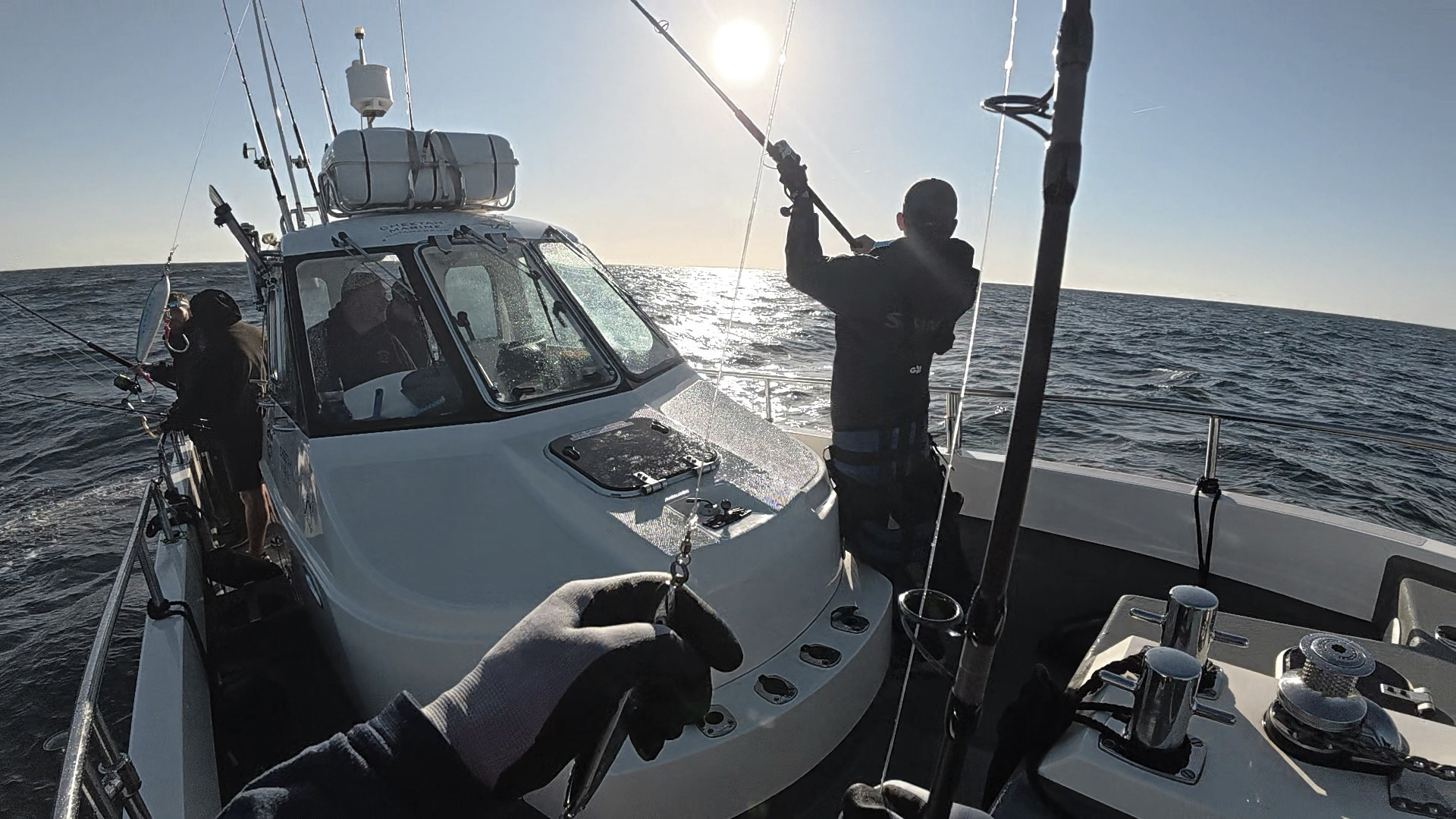
In the sequence shown in the video, the crew observes tuna showing offshore early in the morning. Birds begin to gather, baitfish activity increases and eventually a large surface boil erupts as feeding fish push bait to the top.
Rather than driving directly into the activity, the boat is positioned ahead of the fish so that the angler can cast into their path. This is a small but crucial detail that experienced offshore anglers understand well. Tuna feeding on fast-moving bait often travel quickly across an area, and a lure cast behind the fish will rarely produce a reaction.
By placing the boat ahead of the movement and casting forward into the direction of travel, the lure has a far greater chance of intersecting with feeding fish.
Anglers working bluefin off the UK coastline have reported very similar patterns. Surface activity, bird behaviour and bait movement remain the most reliable indicators that tuna are present and actively feeding.
The Moment of the Strike
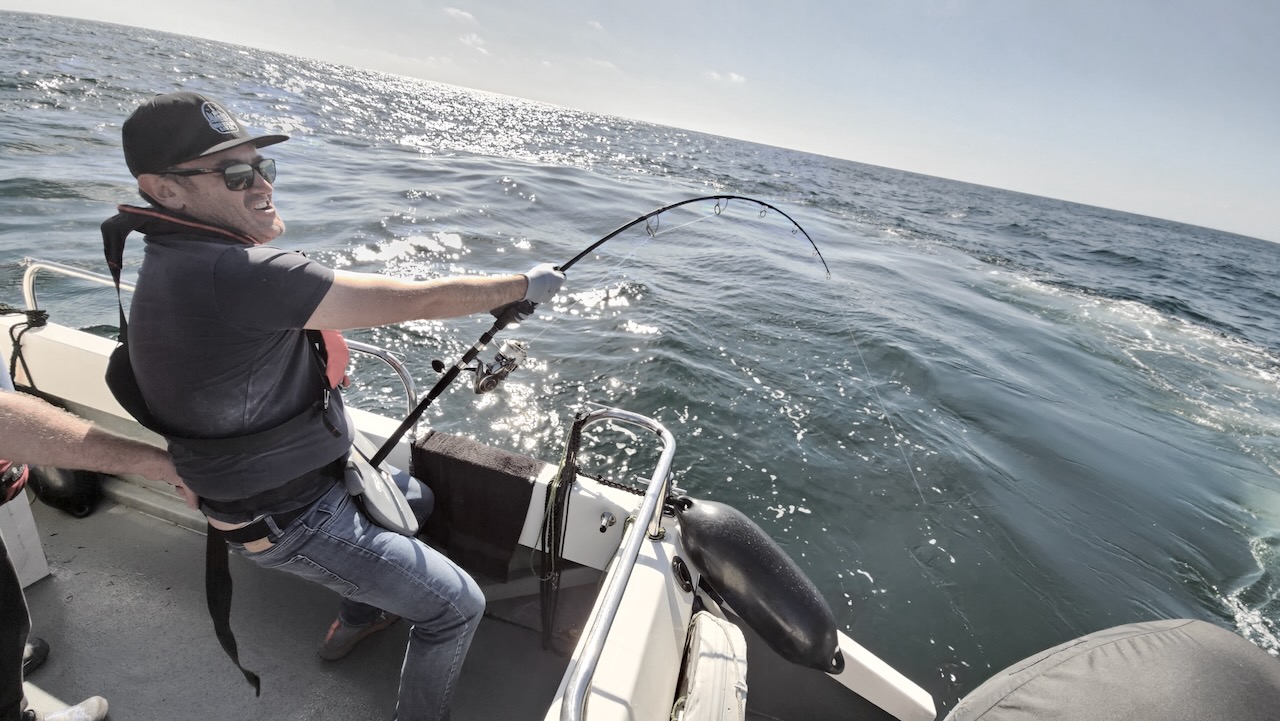
When the strike comes, it happens violently. A large tuna attacking a surface lure accelerates away from the boat immediately, stripping line from the reel at speed. Within moments the fish begins to shake its head in an attempt to throw the hook, followed by long powerful runs.
Eventually the fight settles into the familiar rhythm experienced by anyone who has spent time pulling on big tuna. The fish alternates between deep dives and powerful runs while the angler works to maintain steady pressure and prevent it from gaining positional advantage beneath the boat.
At this stage the contest becomes less about aggression and more about efficiency.
Standing the Rod and Using the Blank’s Repulsive Force
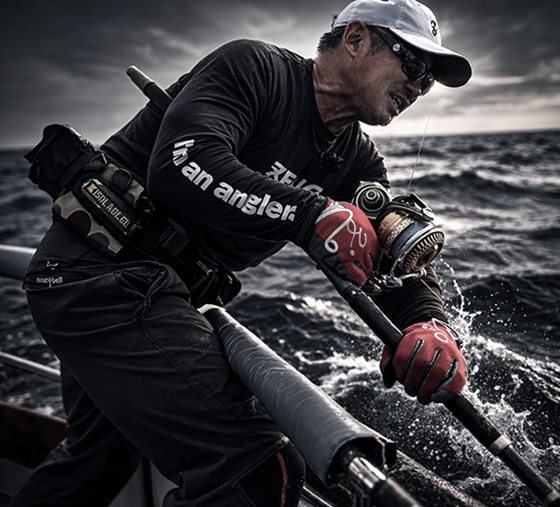
One of the most interesting aspects of Kinoshita’s approach is the emphasis he places on using the rod’s lifting power rather than relying purely on physical strength.
During the fight he explains that once the fish settles and the angler can begin working it properly, the gimbal should be dropped into position and the angler should lean backwards so the rod can begin to do its job. By standing the rod up and allowing the blank to bend deeply, the rod’s repulsive force—or recoil—can be used to lift the fish.
This technique shifts the workload away from the angler’s back and arms and allows the blank itself to generate lifting power. Used correctly, it makes it possible to fight large fish for extended periods without exhausting the angler too quickly.
However, he also makes an important point immediately afterwards. To take advantage of the rod’s lifting power, you need to stand the rod—but when the fish is close you do not want the rod standing straight up.
The reason becomes clear during the next phase of the fight. As the tuna tries to move under the boat, the geometry of the fight changes dramatically. When the fish is directly beneath the hull, a vertical rod angle can put the angler into a poor mechanical position and create clearance problems around the boat.
In this situation Kinoshita deliberately lowers the rod and points it downward while turning the guides away from the boat. This keeps the line clear of the hull and maintains a safer working angle while the fish attempts to get underneath.
Avoiding Bad Fighting Angles Under the Boat
Later in the fight he expands on this point when the tuna manages to get deep beneath the boat.
At one stage he explains that if he pumps the rod from a certain angle, the rod could get stuck in the gimbal. Instead of forcing the lift from a compromised position, he switches to a more controlled straight fight while the boat adjusts position and the fish eventually changes angle.
This moment illustrates an important principle in heavy tackle tuna fishing: the fish often dictates the geometry of the fight. When the line angle becomes too vertical beneath the boat, trying to force an aggressive lift can actually make the situation worse.
By maintaining steady pressure and waiting for the fish to move into a more workable position, the angler can resume using the rod’s lifting power effectively.
Managing Fatigue During a Long Fight
Another useful insight from the fight is the way Kinoshita manages fatigue. Bluefin tuna fights can be extremely demanding, particularly when dealing with large fish that refuse to come up easily.
During the fight he pauses briefly to explain the importance of short recovery periods. By holding the rod straight with both hands and stretching the back, the angler can relieve strain and prevent lactic acid from building up too quickly.
These short resets allow the angler to stay effective over a longer fight. In battles against large tuna this kind of pacing can make a significant difference.
Rod Design and Modern Tuna Rod Construction
The rod itself also plays an important role in the overall fighting strategy.
Kinoshita explains that many older tuna rods were either excessively stiff or lacked sufficient lifting power. Extremely stiff rods placed too much strain on the angler’s body, while softer rods could remain deeply bent without generating the upward force needed to move the fish.
The rod used in the demonstration incorporates a layered construction designed to increase lifting power as the blank bends. According to Kinoshita, this design allows the rod to generate stronger recoil the deeper it loads, effectively helping lift the fish rather than simply absorbing pressure.
He credits this design with allowing him to develop his current fighting style and notes that it has significantly reduced his fight times compared with older rod designs.
Releasing the Fish
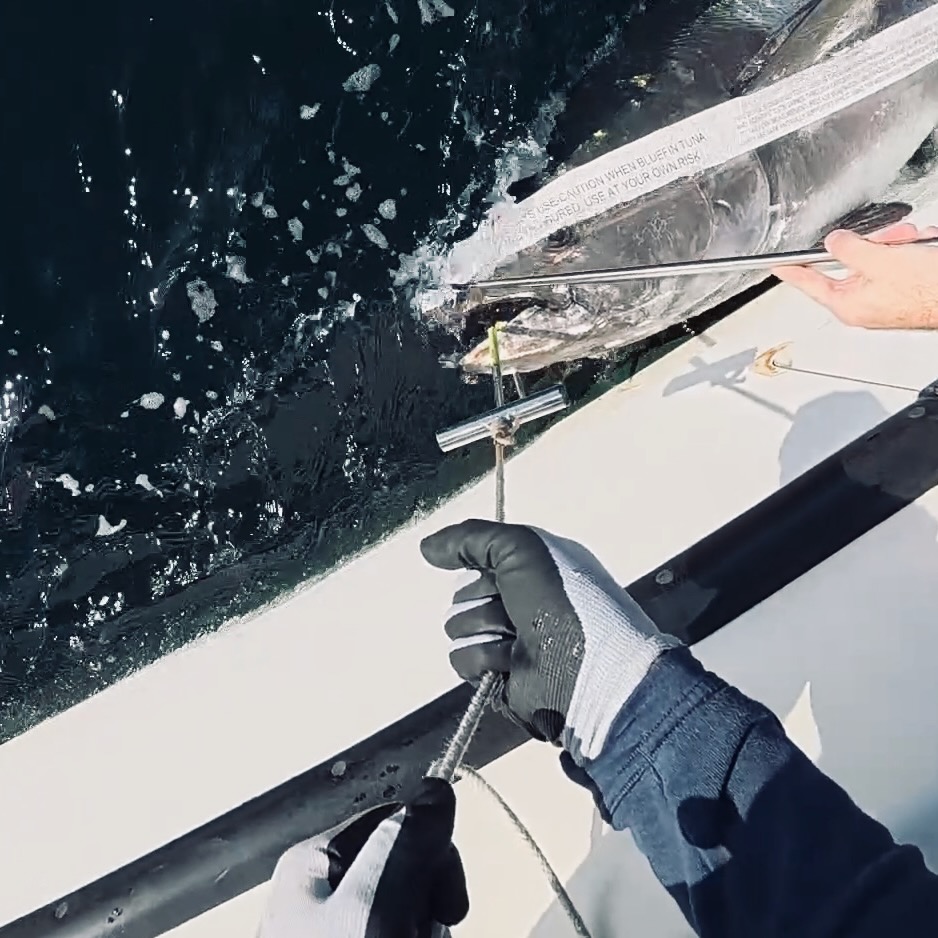
After a demanding fight the tuna is eventually brought under control beside the boat.
Rather than retaining the fish, the crew releases it back into the water. The fish swims away strongly, and Kinoshita comments that he hopes to meet the fish again when it has grown even larger.
Catch-and-release practices are becoming increasingly common in many tuna fisheries around the world, particularly where conservation and stock recovery are priorities. As bluefin continue to return to UK waters, responsible handling practices will likely play an important role in shaping the future of the fishery.
Lessons for UK Anglers
For anglers in the United Kingdom watching the gradual return of bluefin tuna, demonstrations like this provide valuable insight into how modern tuna fishing techniques are evolving.
The principles shown in the fight are not revolutionary, but they reinforce several fundamentals that remain central to successful tuna fishing anywhere in the world. Efficient rod mechanics, thoughtful tackle selection and careful boat positioning all play a significant role when dealing with large fish.
As bluefin encounters become more common around British waters, the techniques developed in established tuna fisheries may increasingly influence how anglers approach these fish closer to home.
Watch the Original Video
Makoto Kinoshita demonstrates these techniques in the following video:
Video courtesy of ZENAQ, featuring angler Makoto Kinoshita.
Read more