The State of the UK Recreational Bluefin Tuna Fishery 2026
Updated: 03 September 2026
Overview
The UK recreational bluefin tuna fishery is growing — and growing fast. To understand exactly who is participating, how much they are investing, and where the sector is heading, UKTuna conducted an independent survey of anglers, vessel operators, charter skippers and marine industry professionals across the UK.
The survey received 76 responses from across England, Scotland, Wales and Northern Ireland. Because this report is specifically about private (non-charter) recreational demand, the 9 respondents who identify wholly or partly as charter skippers/operators have been separated out. All headline figures below are drawn from the remaining 67 private-only respondents, with the charter-inclusive group reported separately for transparency.
This report summarises the key findings.
Who Responded
The survey drew responses from across the recreational tuna community, reflecting the breadth of people now engaged with the fishery.
Of all 76 respondents, 72.4% are private boat owners or operators, 64.5% identify as recreational anglers, 11.8% are charter skippers or operators, and smaller proportions are fishing guides/instructors (7.9%), crew members (7.9%) or connected to the tackle/marine industry (5.3%).
Many respondents hold multiple roles — for example, a private boat owner who also fishes recreationally — which reflects the nature of small-scale offshore fishing operations. Because this report's demand and investment case is specifically about private access, the 9 respondents holding a charter skipper/operator role have been excluded from the figures below.
Among the 67 private-only respondents, 40.3% have applied for a permit only, 31.3% have both applied and participated through a permitted vessel, 14.9% have participated through a permitted vessel without applying directly themselves, and 10.4% have neither applied nor participated. Of those who answered the permit-success question directly, 44.8% (26 of 58) had been successful at least once, and 55.2% (32 of 58) had not.
Charter-Inclusive Respondents (n=9) — Reported Separately
For transparency, the 9 respondents excluded from the private-only figures above show a distinct profile: 6 identify solely as charter skippers/operators (or charter combined with a non-private role such as fishing guide), and 3 hold both a private boat owner/operator role and a charter skipper/operator role. This group reports notably higher average investment (an estimated £30,556 per respondent, against £17,850 for private-only respondents), and 100% report having been successful in obtaining a permit at least once, against 44.8% of private-only respondents who have applied. All 9 also prefer full-season access. These figures illustrate why blending charter and private respondents would materially overstate both private investment levels and, especially, the private permit success rate — the charter group is excluded here because it belongs to a different part of the fishery with a very different access experience, not because its figures were inconvenient.
A National Fishery, Not Just a South West One
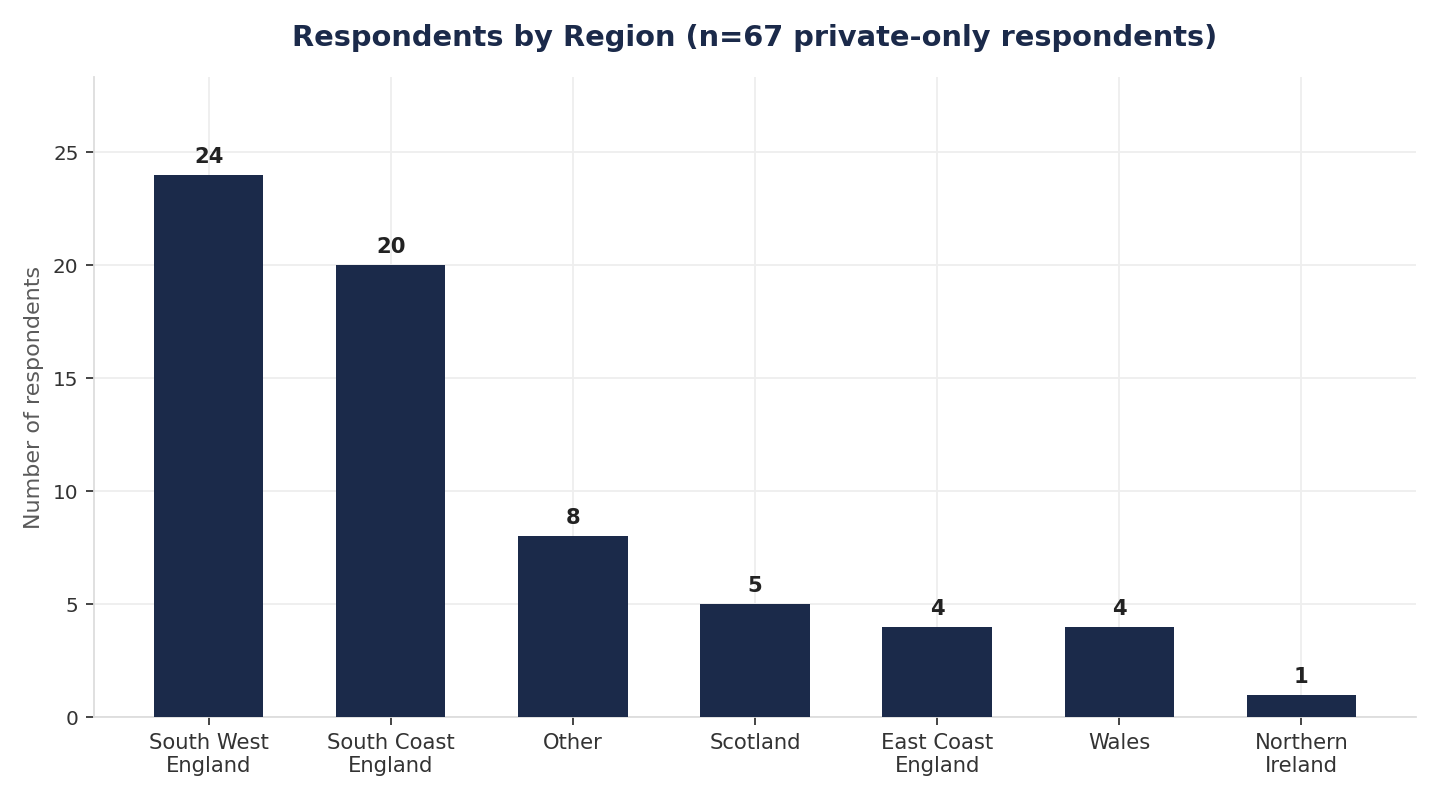
While the South West of England remains the largest single hub of UK recreational bluefin activity, the survey data makes clear this is a fishery with national reach.
64.2% of private-only respondents are based outside the South West, including active communities in Scotland, Wales, the South Coast and the East Coast. Several respondents also noted increasing tuna encounters outside traditionally recognised fishing areas, suggesting the geographic range of the UK recreational fishery may be broader than commonly understood.
Investment: A Sector Already Committed
One of the clearest findings from the survey is the scale of financial investment already made by participants — much of it before reliable long-term access to the fishery was guaranteed.
97.0% of private-only respondents (65 out of 67) reported having already made investments connected to anticipated participation in the recreational bluefin tuna fishery.
41.8% of private-only respondents have already invested more than £10,000, and 16.4% have invested more than £50,000. Using the midpoint of each declared spending band, the 65 respondents who provided a figure have invested an estimated £1.16 million to date, an average of approximately £17,850 per respondent. These are not speculative or modest commitments — they are the kind of capital expenditure that reflects deep confidence in the fishery's long-term value.

What Has Been Invested In
Respondents reported investment across a range of categories (multiple selections permitted), including rods, reels, boat upgrades, safety equipment, marine electronics, and travel and accommodation. The picture this creates is of a community that has not just bought a rod and reel. The majority have invested in vessels, safety systems and navigation electronics — the kind of infrastructure that underpins serious offshore fishing capability.
Participation: Well Beyond Occasional
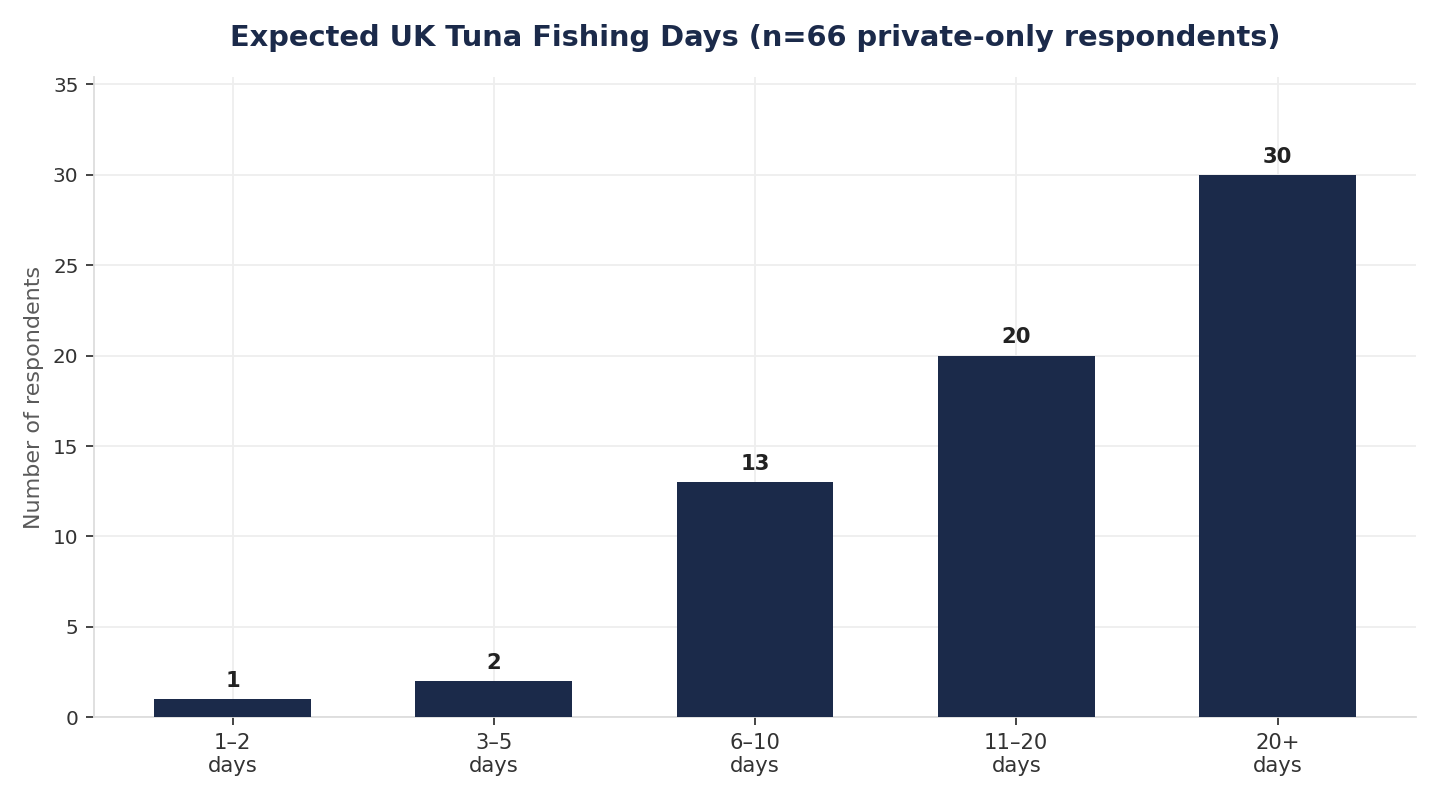
The survey asked respondents how many tuna fishing days per year they would realistically expect to participate in, given current or anticipated access.
95.5% of private-only respondents expect to fish for six days or more per year, and nearly half — 45.5% — expect to participate in more than 20 days annually. This profile is not consistent with casual or occasional interest. It reflects a community of dedicated offshore anglers for whom tuna fishing is a central part of their season.
Future Spending: Significant Potential
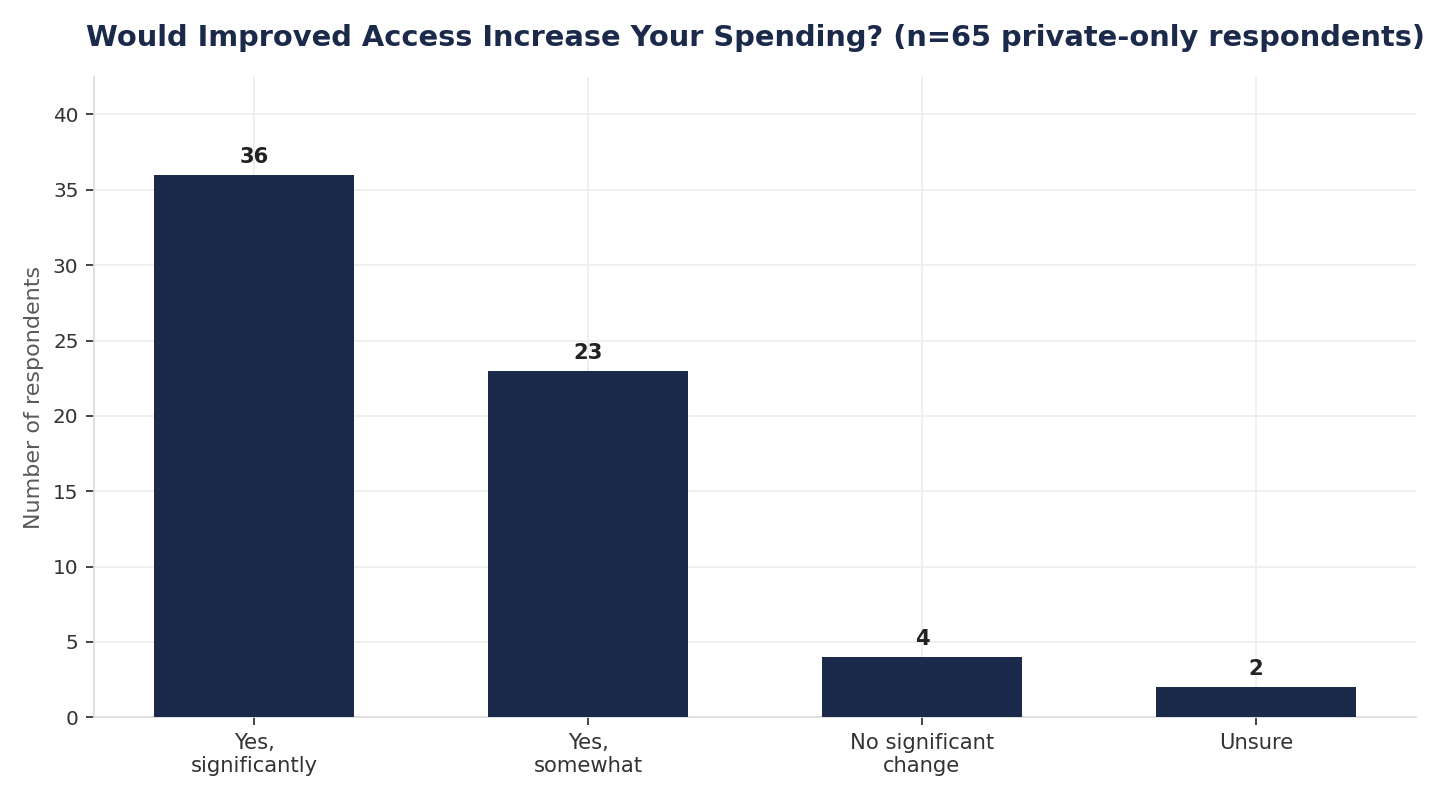
The survey asked whether respondents would increase their spending if access to the fishery became greater or more regular. The results were clear.
88.1% of private-only respondents said yes — either significantly (53.7%) or somewhat (34.3%). 6.0% indicated no significant change, and 3.0% were unsure.
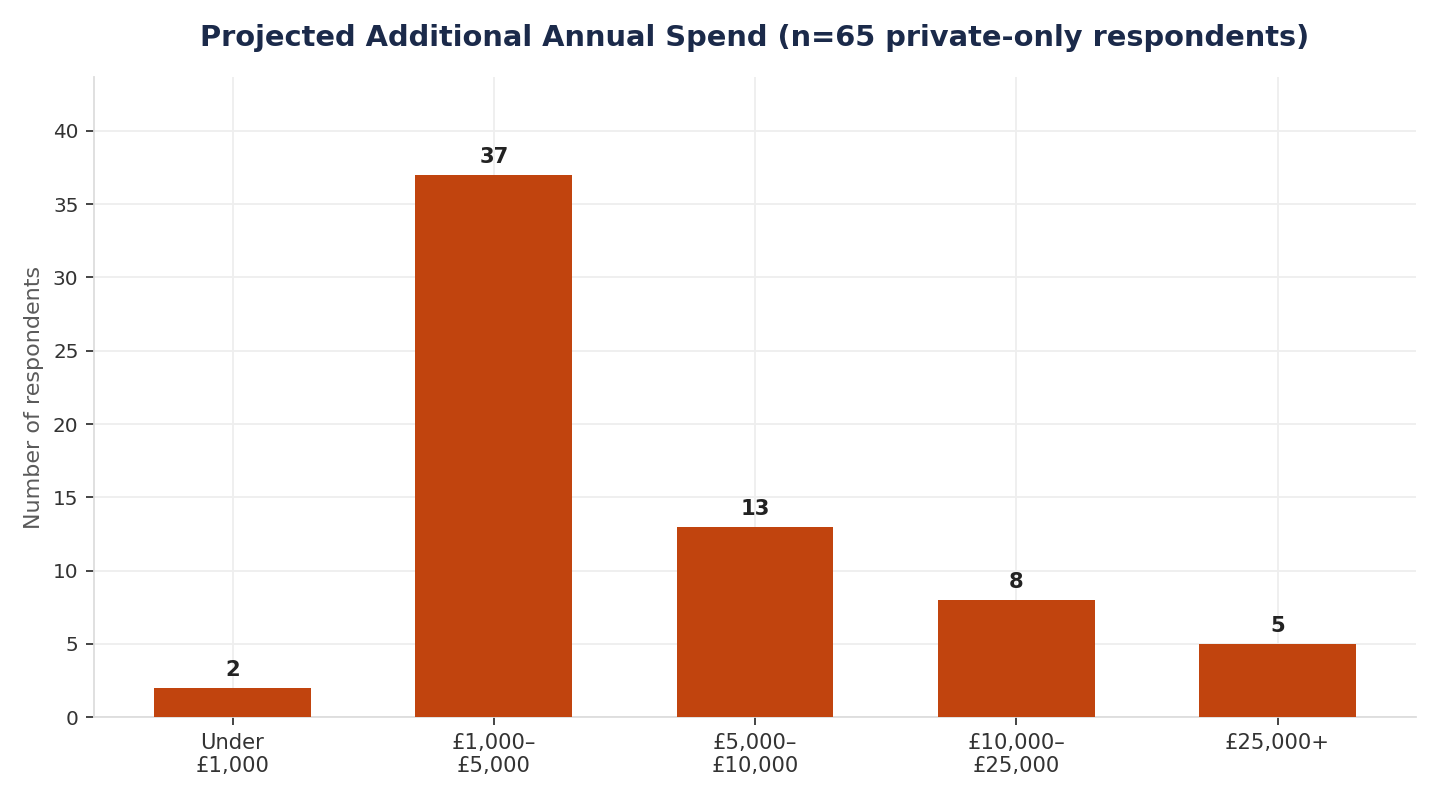
Using the midpoint of each declared band, private-only respondents collectively project a further £474,500 in additional spending over the next 12 months, an average of approximately £7,300 per respondent, contingent on improved access. 19.4% of private-only respondents projected additional annual spending above £10,000. This spending would flow into UK coastal economies: tackle and marine electronics retailers, boatyards, safety equipment suppliers, and travel and accommodation providers.
Preferred Access Level
The survey also asked what level of access would best suit respondents' operational needs.
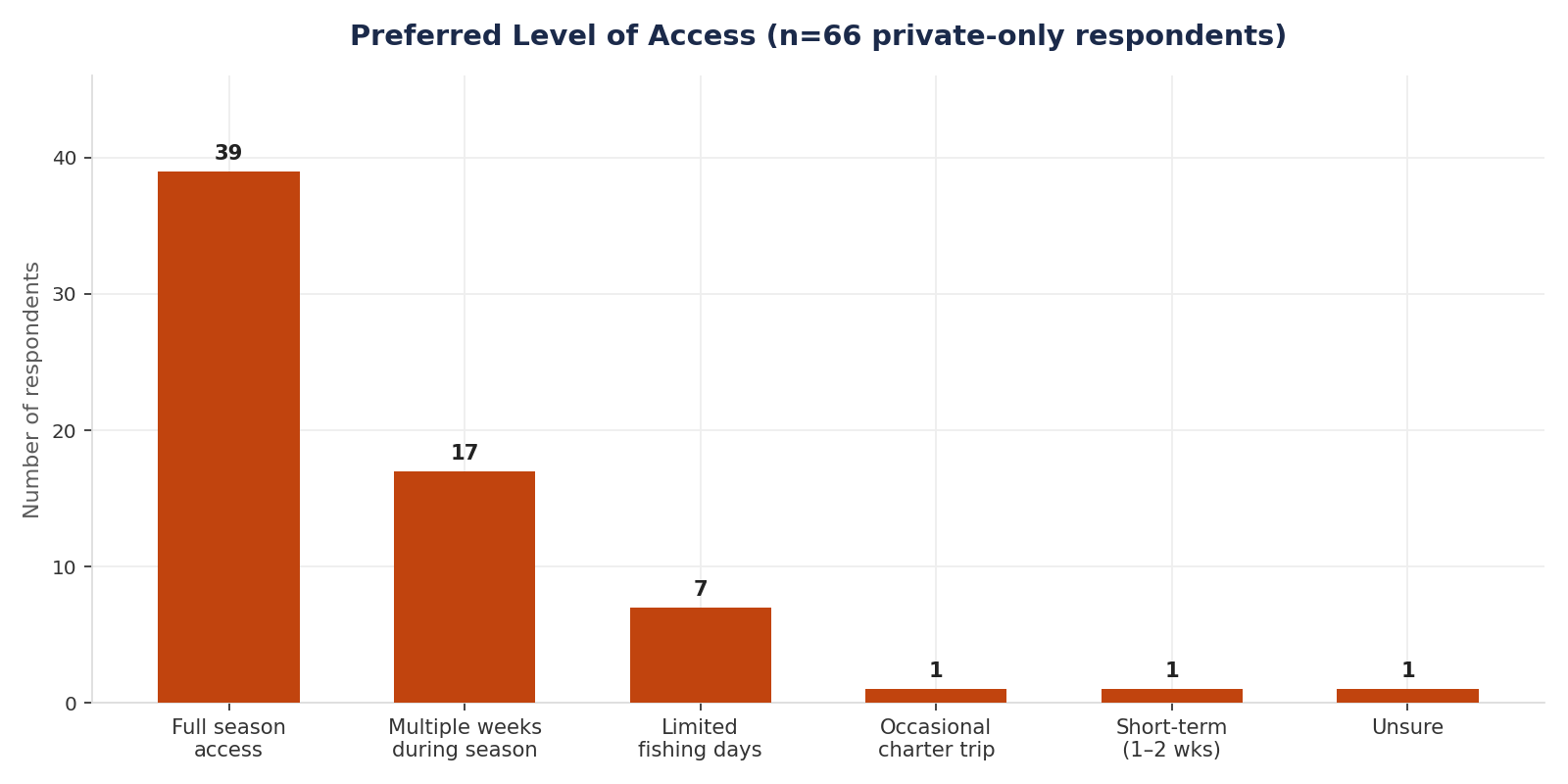
58.2% of private-only respondents identified full season access as their preferred arrangement, with a further 25.4% seeking multiple weeks. Several respondents noted in comments that flexible access — rather than fixed advance dates — is especially important given the weather dependency and logistical demands of offshore fishing.
Techniques: A Multi-Method Fishery
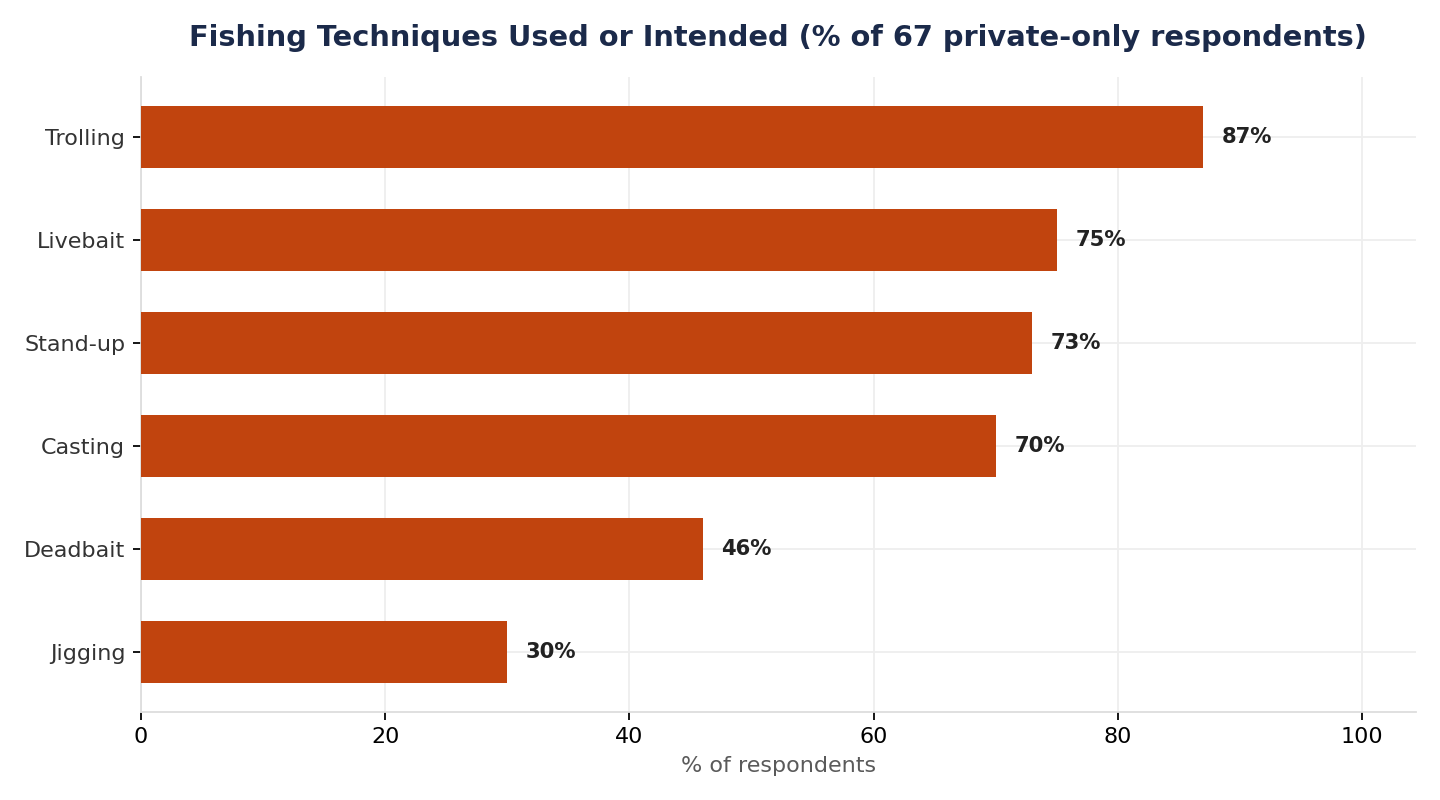
The survey documented the range of techniques participants use or plan to use. Results show this is not a fishery defined by a single style of fishing.
Trolling is the most widely adopted method, used or intended by 86.6% of private-only respondents. Stand-up fishing (73.1%) and casting (70.1%) — the methods most visible in UK tuna media — are both widely used, but the data confirms that the UK recreational fishery has diversified significantly. The majority of respondents use or intend to use multiple techniques depending on conditions.
What Respondents Said
Alongside the quantitative data, the survey collected open-ended comments from participants. A number of themes emerged consistently.
Experience and offshore capability. Many respondents described extensive offshore fishing backgrounds, with references to blue water game fishing experience, vessel qualifications and multi-season bluefin participation. The recreational tuna community is not a newcomer community.
Investment made ahead of access. A recurring theme was the willingness to commit significant capital — vessels, electronics, specialist tackle — in anticipation of the fishery, even without guaranteed future access. This reflects strong long-term confidence in the fishery's development.
Flexibility and weather dependency. Respondents repeatedly noted that offshore fishing is subject to weather windows, work commitments and sea conditions that make fixed-date participation impractical. Flexible access arrangements were widely described as an operational necessity rather than a preference.
Geographic spread of bluefin encounters. Several respondents noted sightings and encounters in waters not traditionally associated with UK tuna fishing, including offshore areas of Scotland, the East Coast and Wales. This aligns with wider observations of expanding bluefin distribution in north-east Atlantic waters.
Summary: Key Data Points
For quick reference, the headline findings from the 2026 UKTuna survey (private-only respondents, n=67, unless stated):
- 76 total respondents surveyed; 67 private-only (9 charter-inclusive respondents reported separately)
- 97.0% have already made investments connected to the fishery
- 41.8% have invested more than £10,000; 16.4% more than £50,000
- 95.5% expect to fish six or more days per year
- 45.5% expect to fish more than 20 days per year
- 88.1% would increase spending with improved or more reliable access
- 19.4% project additional annual spending above £10,000 with better access
- 64.2% are based outside the South West of England
- 58.2% prefer full season access; a further 25.4% seek multiple weeks
- 86.6% use or plan to use trolling; 73.1% stand-up fishing; 70.1% casting
- 44.8% of those who have applied report having been successful at least once
About This Survey
The UKTuna survey was conducted independently to document participation, investment, and demand within the UK recreational bluefin tuna sector. It is designed as a longitudinal resource — a baseline against which the development of the fishery can be tracked over time.
This report has been updated to reflect the latest survey responses received, and to exclude charter vessel operators from the private applicant figures, so the evidence speaks specifically to private recreational access. UKTuna thanks everyone who took part — the results form the baseline dataset for tracking the fishery's development going forward.
Report compiled by UKTuna. Data current as of September 2026. All figures derived from survey responses. For queries contact UKTuna via uktuna.com.
Read more